
Use a one-off influencer campaign for a defined moment and an always-on program for repeated buyer education, creative learning and creator relationships. Neither is inherently better. The right choice depends on how often your market needs a credible message and whether your team can support continuous work.
Longer partnerships can improve product fluency and reduce repeated onboarding, but they also create a standing operational commitment. A campaign can focus resources around a launch, yet it may end before the team learns which creator-message combinations deserve repetition.
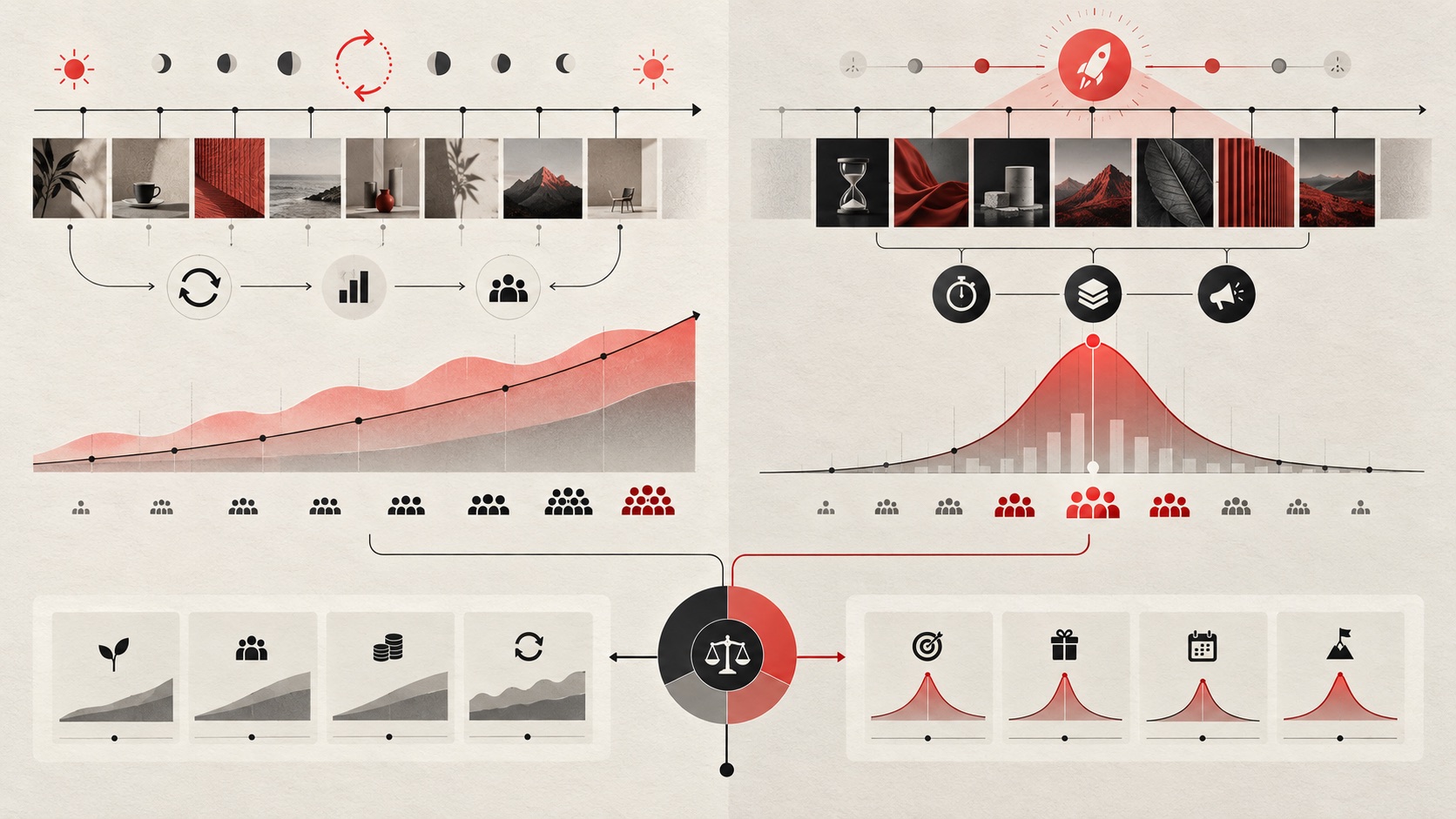
Compare the operating models
| Question | One-off campaign | Always-on program |
|---|---|---|
| Best for | Launch, event or focused test | Ongoing category and product education |
| Creator relationship | Project-based | Repeated and developmental |
| Learning | Concentrated snapshot | Compounding tests and benchmarks |
| Operations | High temporary intensity | Steady sourcing, briefing and reporting |
| Budget | Bound to a defined window | Reserved across a period |
Choose a campaign when the moment is truly discrete
A campaign is appropriate when the product has a clear release, the target audience is narrow or the brand is testing a new channel. Define the learning goal as well as the communication goal. Capture creator, message, format and audience evidence so the work can inform the next decision.
Do not build a permanent roster before validating product readiness and working fit. A focused pilot is often the simplest responsible starting point.
Choose always-on when repetition creates value
Always-on programs make sense when buyers repeatedly encounter new use cases, objections and product updates. They can combine recurring expert voices with a wider test layer of new creators. Repetition gives creators more product fluency and lets the brand compare performance across multiple briefs rather than one launch anomaly.
The model still needs boundaries: a quarterly objective, a planned content cadence, renewal criteria and a budget for paid amplification or rights where needed. “Always on” should not mean “publish constantly without a decision framework.”
Move from pilot to program in stages
Start with a campaign that uses more than one creator role and message angle. Repeat the strongest partnerships once, then assess whether the improvement came from familiarity, format or timing. Build a core roster only after creators show reliable audience fit, product accuracy and working discipline.
Reserve part of the program for new voices so the roster does not become closed and repetitive. Use the same measurement definitions over time, while allowing campaign-specific objectives to change.
Judge the full operating cost
Compare creator fees, product access, production support, review time, rights, paid media and reporting. Always-on work may lower onboarding effort per asset, but it ties up budget and internal attention. One-off work may look cheaper while repeatedly paying the same setup cost.
Photura's pricing reference separates project and retainer-style scopes. Use the B2B SaaS strategy guide to define creator roles and the KPI guide to set renewal evidence.
Why the operating model matters now
CreatorIQ reports that average annual influencer-marketing budgets among its respondents grew 171% year over year, 71% of organizations increased investment and nearly two-thirds of new spending was reallocated from traditional paid and digital channels. The study covers 1,723 brands, agencies and creators.[1] These figures describe the surveyed market, not a budget recommendation. They do show why brands need a durable choice between campaign bursts and ongoing creator operations.
IAB projects the broader US creator ad market at $37 billion in 2025 and says brands now use creator work across awareness, audience development, reputation and sales objectives.[2] One operating model will not serve all of those jobs equally.
Compare the two models honestly
| Dimension | Campaign-led | Always-on |
|---|---|---|
| Best for | Launch, event, seasonal offer or defined announcement | Category education, recurring use cases and sustained trust |
| Creator relationship | Often project-based | Repeated, with learning and audience familiarity |
| Planning | Concentrated production and approvals | Continuous pipeline and editorial cadence |
| Measurement | Clear campaign window, risk of short-term bias | Better trend view, harder to isolate one moment |
| Budget profile | Peaked around a milestone | Reserved capacity across the year |
| Common failure | One burst with no reuse or learning loop | A calendar of posts with no strategic progression |
What an always-on system actually requires
An always-on program is not “post every week.” It needs a creator portfolio, recurring audience questions, a content architecture and a decision cadence. Divide the portfolio into anchor experts, repeat practitioners and flexible creative testers. Give each group a distinct job. Maintain product access and fast factual support so returning creators can deepen the story instead of repeating an introduction.
Plan themes around buyer needs: category education, workflow demonstrations, comparisons, customer proof and objection handling. Rotate formats without changing the audience problem every month. Preserve the strongest organic assets for licensed reuse or paid testing where rights and economics fit.
How to make a campaign burst compound
A campaign should still leave infrastructure behind. Record the creators who were reliable, the messages that held attention, the objections in comments, the assets worth licensing and the audience segments that responded. Schedule a follow-up decision before the final report is filed. Without that step, every launch restarts sourcing and learning from zero.
For B2B, LinkedIn reports that 67% of surveyed buyers engage with influencer content during consideration and research.[3] That argues for continuity when the product requires ongoing education, but only if the repeated content adds new evidence rather than frequency alone.
A practical hybrid calendar
| Cadence | Activity | Decision produced |
|---|---|---|
| Monthly | Expert or practitioner content around one buyer question | Which message and creator role deserves repetition? |
| Quarterly | Concentrated product moment with multiple formats | Which assets should receive paid distribution? |
| After each wave | Asset-level performance and qualitative review | Repeat, revise, license or stop? |
| Twice yearly | Portfolio, rights, risk and market review | Where should budget and creator mix change? |
Budget capacity, not only posts
Reserve for creator fees, product or access, production support, usage rights, paid media, reporting and contingency. Always-on work also needs coordination capacity: fast approvals, creator communication and rights tracking. A lower monthly content count with consistent operations can outperform a larger calendar that stalls in review.
Use Photura's pricing reference only as an indicative starting point; the final scope and agreement control.[4] Choose campaign-led when timing and concentration matter most, always-on when trust and learning need continuity, and hybrid when the brand has both recurring education and major product moments.
From decision to brief
Choose a cadence your team can operate well.
Photura can scope a launch activation, repeatable creator program or staged path between them—without committing you to cadence before the evidence supports it.
Discuss your briefSources & references
- [1] CreatorIQ — State of Creator Marketing 2025–2026Industry research on investment, measurement, paid amplification and creator partnerships
- [2] IAB — 2025 Creator Economy Ad Spend & Strategy ReportBuyer research on creator selection, objectives, measurement and operating maturity
- [3] LinkedIn — How to Effectively Leverage Influencers in B2B MarketingPlatform research and guidance on expertise, trust and B2B creator selection
- [4] Photura pricing reference — September 2026First-party indicative scope and pricing; the approved agreement controls