
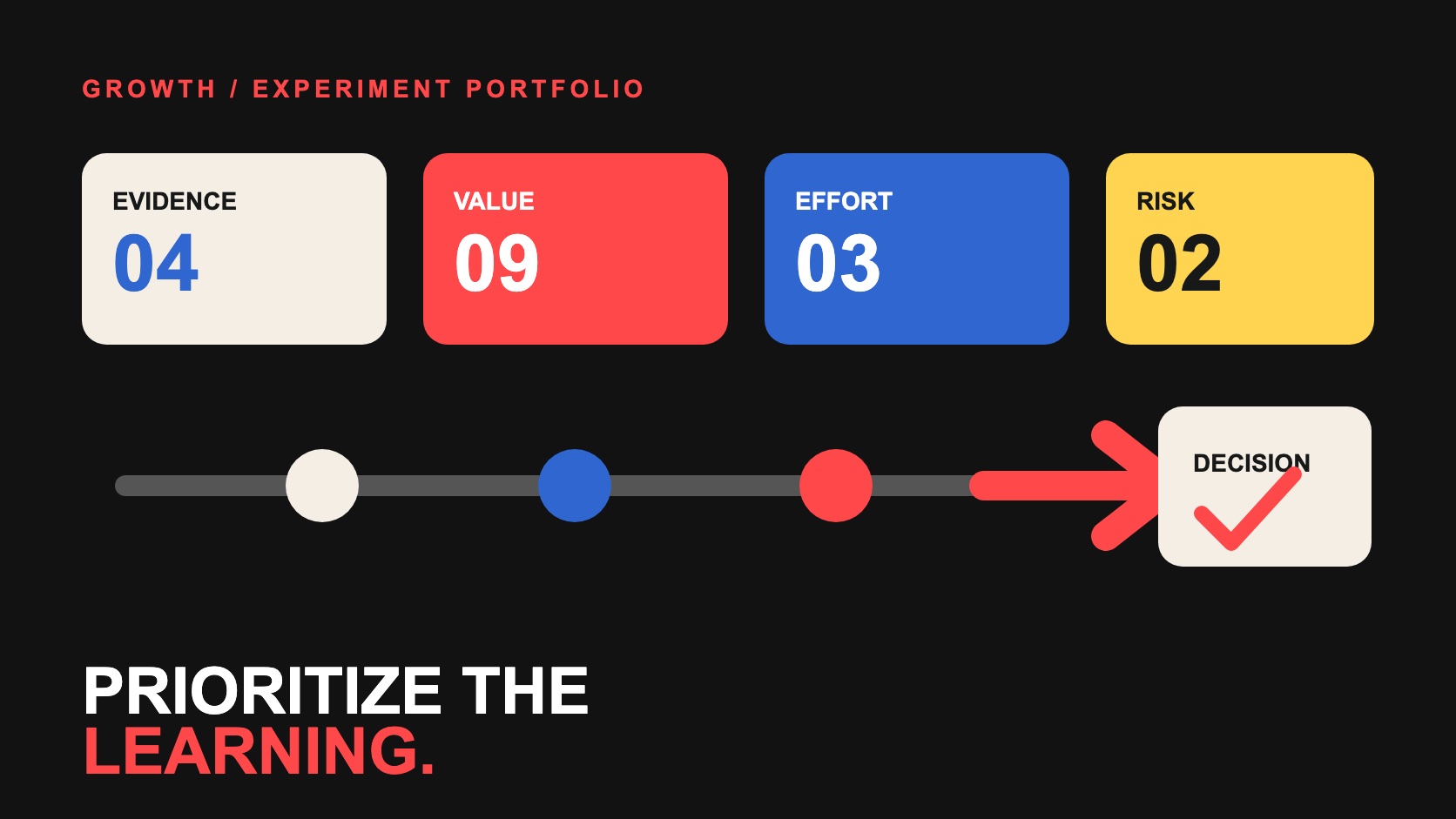
Prioritize SaaS growth experiments by the value of the decision they can unlock, the evidence behind the hypothesis, the reachable audience, the cost and operational risk, and whether the result can be measured clearly. Use a scoring rubric to structure judgment, not to automate it. Then protect a balanced portfolio instead of selecting only cheap tests or executive favorites.
An experiment backlog becomes useful when every item describes a belief that could be wrong and the action that would follow. “Try LinkedIn” is a task. “A proof-led workflow demo will produce more qualified trials than a feature-led ad among operations leaders” is a testable hypothesis with a business consequence.
Set an entry standard for the backlog
Require an audience, observed problem, proposed change, expected mechanism, primary metric, quality guardrail, minimum evidence, owner and next decision. Link the source of the hypothesis: product behavior, sales objection, search demand, customer research, creator feedback or prior test. Do not give anecdote and controlled evidence the same label.
Merge duplicate ideas that test the same underlying belief. Split ideas that change audience, offer and creative simultaneously unless the purpose is explicitly a bundled strategy test. Reject experiments that cannot be implemented, measured or acted on within the planning horizon.
Score dimensions that matter to the business
| Dimension | Question | Scoring caution |
|---|---|---|
| Decision value | What meaningful allocation or product choice could change? | Do not equate visibility with value |
| Evidence | How credible is the observed problem and mechanism? | Separate fact, signal and opinion |
| Reach | How much eligible traffic or audience is available? | Reach is not impact |
| Effort | What creative, engineering, media and review work is required? | Include opportunity cost |
| Risk | Could the test harm trust, compliance, data or operations? | A low probability can still be material |
| Readiness | Can exposure, outcome and quality be observed? | Instrumentation is not optional setup |
Use a small anchored scale and write examples for high, medium and low. Weight dimensions according to the current strategy, then review the top items in conversation. Decimal precision does not make uncertain assumptions scientific. Record the reason an item was promoted, delayed or rejected.
Balance the experiment portfolio
Reserve capacity across horizons: improve an existing path, test a new message or audience, and explore a larger strategic assumption. Also balance funnel stages and channels so the backlog does not optimize clicks while activation, retention or sales quality remains the constraint.
Limit work in progress. Several underpowered tests running simultaneously can compete for traffic, creative attention and implementation support. Sequence related experiments so one result informs the next. Keep a small reserve for urgent market or product learning without allowing every stakeholder request to become urgent.
Turn the selected idea into an interpretable test
Write the hypothesis, unit of assignment, control, treatment, audience, dates, success metric, guardrails and stopping rule. Change one major variable where the decision requires attribution. Google's experiment guidance recommends clear hypotheses tied to business goals and preserving records for future prioritization.
Use platform experiments when they fit the question. Google Ads' custom experiment documentation explains traffic and budget splits and cautions that changes during a test can make results harder to interpret. Platform availability and requirements change, so verify the current account before committing a method.
Separate the primary outcome from quality guardrails
Choose one primary metric that matches the hypothesis, then define downstream quality and harm signals. A lower cost per lead can fail if accepted pipeline declines. A higher activation rate can hide a smaller eligible audience. State the system of record, attribution window and acceptable latency.
Google Analytics defines attribution as assigning credit across ads, clicks and other factors in a user's path. Attribution reports describe a model of observed paths; they are not automatically causal proof. Use randomized experiments or supported lift methods when the question is incremental impact.
Fund the full cost of learning
Estimate media, production, engineering, analytics, legal review, sales handling and opportunity cost. Include the replacement creative or operational follow-up required if the test works. A cheap test whose result cannot be implemented has low decision value. A more expensive test can be rational when it resolves a major allocation question.
Confirm enough eligible traffic and time exist to observe the outcome. If not, reduce the number of variants, choose a nearer leading indicator with explicit limits, or treat the work as qualitative discovery. Do not promise statistical certainty from a sample the plan cannot produce.
Run a decision review, not a winner announcement
At the end, show the setup, data quality, result range, guardrails, outside changes and limitations. Classify the result as supported, contradicted, inconclusive or invalid. Decide whether to adopt, iterate, rerun, hold or stop. Avoid calling a small directional movement a universal win.
Record unexpected behavior and segment differences only as exploratory findings unless the design supported them. Protect negative and inconclusive results from deletion. They prevent the same idea from returning with a new name and give future teams the context to design a better test.
Connect prioritization to a recurring growth cadence
Review evidence and backlog health on a predictable schedule. Update scores when product, market or capacity changes. Keep the roadmap visible to creative, product, sales and analytics owners so feasibility and downstream quality enter before launch rather than after results.
Retire ideas deliberately. Mark why an item was rejected, which assumption changed and what evidence would justify reopening it. A backlog that only grows hides the real strategy. The active list should express current choices, while the archive preserves learning without competing for weekly attention.
Audit the portfolio quarterly for bias. Teams often favor acquisition over retention, measurable channels over important qualitative work, and familiar tactics over uncertain strategic questions. Adjust capacity intentionally, but do not force an artificial balance when one verified constraint is clearly dominant.
Publish the decision log internally in plain language. Stakeholders should be able to see what is running, what it costs, when it ends and which decision follows. Visibility reduces duplicate tests and makes it easier to protect a clean setup from last-minute changes.
The launch measurement plan defines a cross-channel evidence spine, while the paid-media allocation guide protects readiness, testing and scale envelopes. Photura's connected growth system can turn that portfolio into coordinated creator, creative and distribution work.
From decision to brief
Prioritize the learning that changes the next decision.
Photura can connect channel strategy, creative production and measurement into a disciplined growth experiment portfolio.
Discuss your briefSources & references
- [1] Google Ads — Test with confidence with the Experiments pageOfficial guidance on clear hypotheses, controlled changes, experiment records and decisions
- [2] Google Ads — Set up a custom experimentOfficial guidance on traffic splits, success metrics and keeping tests interpretable
- [3] Google Analytics — AttributionOfficial definition of assigning credit across ads, clicks and touchpoints