
TikTok is usually stronger for fast creative testing and repeated discovery; YouTube is usually stronger for durable explanation, search-led discovery and considered product evaluation. A SaaS brand may need one, the other or a connected system—but the product demonstration should decide before platform fashion does.
Compare the jobs each platform can do
| Decision factor | TikTok | YouTube |
|---|---|---|
| Entry point | Fast hook and use-case discovery | Question, review or tutorial intent |
| Depth | Concise demonstrations and iterations | Detailed workflows and trade-offs |
| Testing | More creative variations quickly | Fewer, higher-investment assets |
| Longevity | Can move quickly through feeds | Can continue through search and recommendations |
| Amplification | Spark Ads can promote authorized posts | Paid promotion and broader Google Ads options |
Use TikTok when the product has a fast visible payoff
TikTok can work when one problem, transformation or surprising workflow is understandable quickly. It supports rapid testing of hooks, creators and use cases. The brief should protect accuracy without forcing every creator into identical pacing.
TikTok's Spark Ads can use authorized organic posts in paid delivery, which makes rights and authorization part of planning—not an afterthought. A good organic post is not automatically licensed for unlimited advertising.
Use YouTube when evaluation needs depth
YouTube suits products that benefit from setup, comparison, a complete workflow or explanation of limitations. A dedicated video can give the product narrative ownership; an integration can place it inside content the audience already intended to watch. Our format comparison covers that decision.
YouTube requires creators to declare branded content under its policies, while brands and creators remain responsible for applicable legal disclosures. Plan product access and factual review early because a detailed video is expensive to rebuild late.
Let audience behavior override stereotypes
Do not assume every B2B buyer lives only on YouTube or every consumer product belongs on TikTok. Review where relevant creators already explain the problem and where audience comments show real evaluation. A niche technical audience can exist on either platform.
Use a connected mix when the assets have distinct roles
A YouTube explanation can anchor consideration while short-form creators test entry points and objections. That does not mean cutting one long video into every short asset. Each platform needs a native idea, pace and creator relationship. Connect measurement through consistent campaign naming and landing destinations.
Choose by production economics and evidence
Compare likely reach, audience quality, creator fees, production support, approval load, rights and paid distribution. Run a small platform test when the evidence is weak. For YouTube pricing, read what brands should pay creators; for broader planning, use the B2B SaaS creator model.
Start with what the platforms actually support
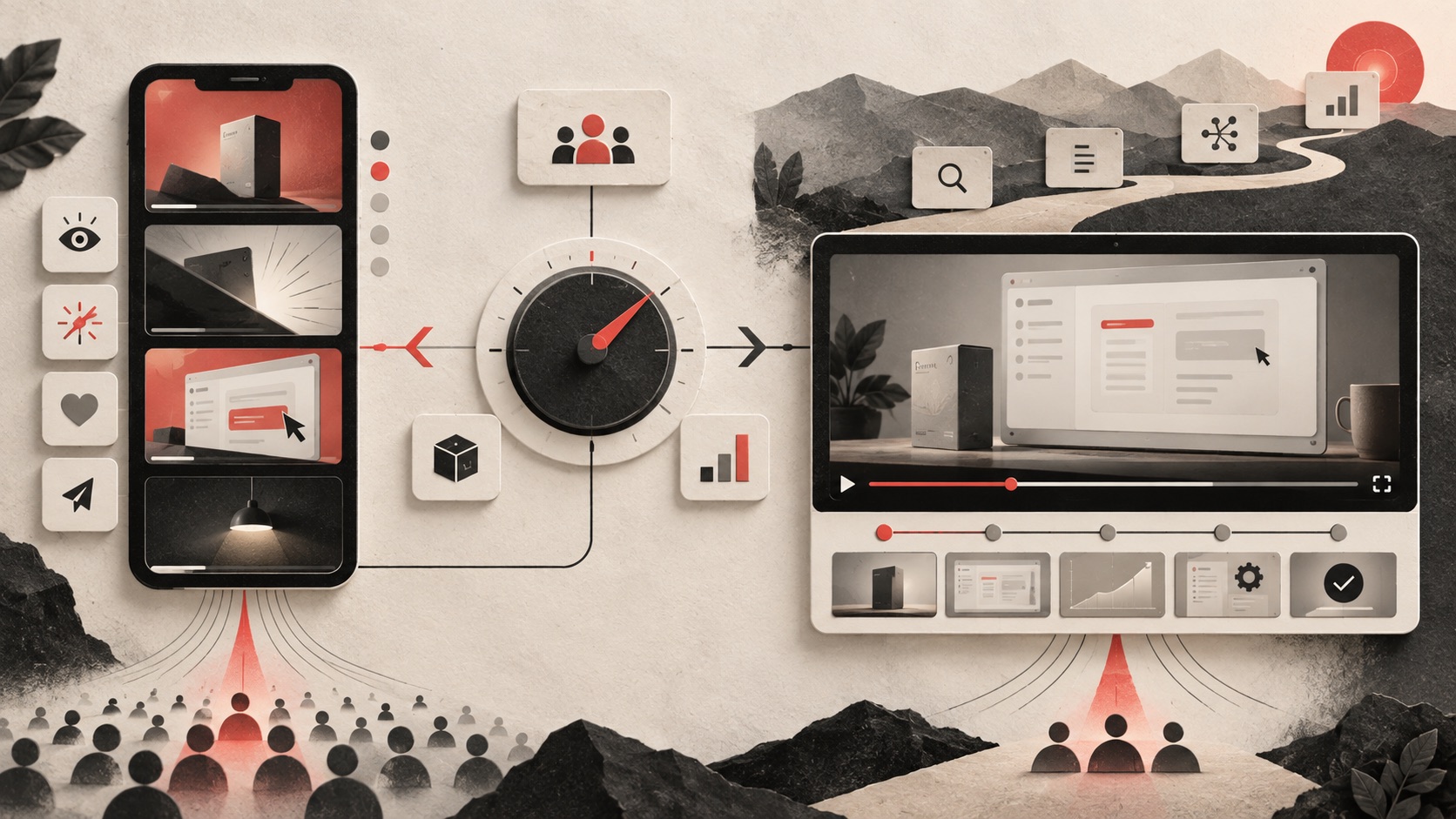
TikTok describes Spark Ads as a native format that lets advertisers use authorized organic TikTok posts from a creator or brand account in paid campaigns.[1] That can connect organic creator proof with paid distribution, but authorization, duration and content rights still need to be planned.
YouTube's branded-content policies require creators to declare paid promotion and explain platform restrictions around embedded third-party promotions.[2] The platform is suited to both dedicated videos and integrations, with a durable search and recommendation environment, but detailed production usually carries greater research and revision cost.
Score the product, not the platform's popularity
| Question | Signal toward TikTok | Signal toward YouTube |
|---|---|---|
| How fast is the payoff visible? | Seconds; a transformation or shortcut | Minutes; setup, workflow or comparison |
| How many messages must be tested? | Many hooks and use cases quickly | A smaller number of deeper narratives |
| How does the buyer research? | Feed discovery and social proof | Intent-led review, tutorial and search |
| How much context protects accuracy? | One bounded claim can stand alone | Trade-offs and constraints need explanation |
| How should the asset compound? | Iteration plus Spark Ads | Longer shelf life plus clips or integrations |
The platform planner below turns these considerations into a directional score. It is not a media forecast. Real creator availability, audience composition, costs and product readiness can override the result.
Design a fair platform test
Do not compare one highly produced YouTube review with one low-context TikTok post and call the result a platform conclusion. Give each channel a native job. For example, YouTube can answer “how does the full workflow compare?” while TikTok tests “which pain point earns immediate attention?” Align the product offer and landing destination, but let format, pacing and creator voice remain native.
Define the learning question before spend: audience fit, hook strength, product comprehension, qualified traffic or acquisition. Use more than one creator or asset when possible, because one creator-platform combination is not the platform. Preserve fees, rights and paid spend separately.
Three common SaaS scenarios
Visible productivity tool: Start with TikTok or short-form when the before-and-after is obvious and many use cases can be tested. Promote selected posts only after confirming authorization and usage rights. Technical workflow product: Start with YouTube when setup, integration and limitations determine trust. Use chapters, links and an accurate test environment. New category: Combine them—deeper explanation establishes the model while short-form creators test language and objections.
Use platform-appropriate evidence
| Layer | TikTok evidence | YouTube evidence |
|---|---|---|
| Attention | Early hold, completion and rewatches where available | Average view duration, retention and meaningful watch depth |
| Response | Shares, saves, profile actions and relevant comments | Comments, description clicks and subsequent viewing |
| Business | Tracked sessions, trials or purchases | Tracked sessions, trials, assisted and delayed outcomes |
| Learning | Winning hooks, creators and use cases | Questions, objections and high-intent topics |
IAB says creator selection and measurement remain central buyer challenges even as investment grows.[3] CreatorIQ's 2025–2026 report says paid amplification strategies rank strongly in reported ROI, while measurement and brand safety remain priorities.[4] The strategic answer is not choosing a winner in the abstract. It is assigning each platform a job, licensing strong assets deliberately and measuring the evidence that job should produce.
Before committing the full budget, write a one-page test charter: product use case, audience, creator role, platform job, asset count, paid-use assumption, primary KPI, tracking method and the decision date. If the results are mixed, the charter helps separate a weak platform hypothesis from a weak creator, brief or destination. The output of a pilot should be a next decision, not only a performance screenshot.
TikTok vs. YouTube platform fit
Directional planning tool · not a reach, cost or performance forecast
TikTok 49 · YouTube 67
From decision to brief
Choose the format the product can earn.
Photura can build a platform mix around your SaaS workflow, buyer and launch goal, then connect creator content to paid distribution where the scope supports it.
Discuss your briefSources & references
- [1] TikTok for Business — About Spark AdsOfficial description of promoting organic creator or brand posts as Spark Ads
- [2] YouTube — Branded Content PoliciesOfficial requirements for branded content and paid-promotion declarations
- [3] IAB — 2025 Creator Economy Ad Spend & Strategy ReportBuyer research on creator selection, objectives, measurement and operating maturity
- [4] CreatorIQ — State of Creator Marketing 2025–2026Industry research on investment, measurement, paid amplification and creator partnerships