
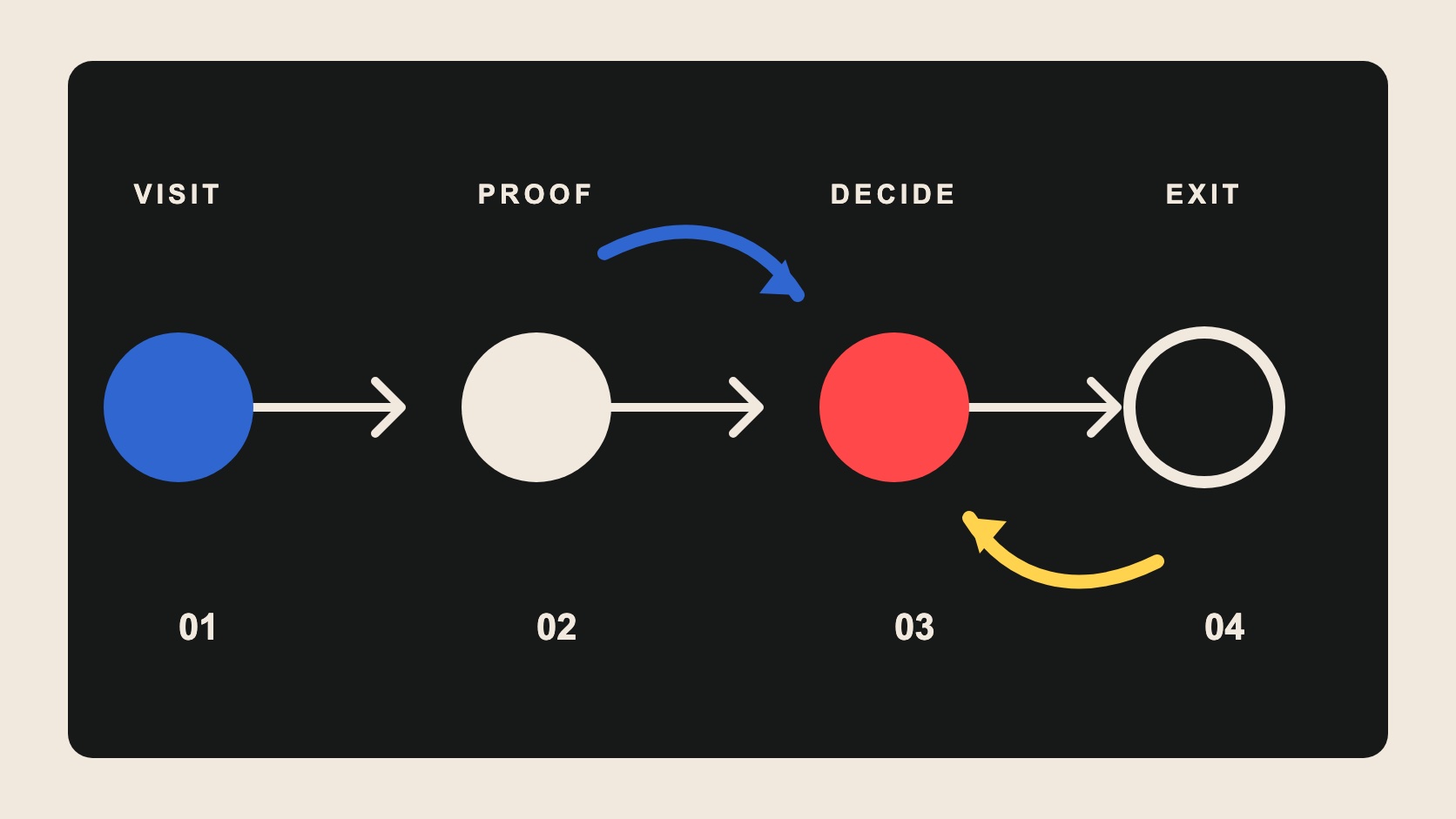
A useful B2B SaaS retargeting strategy groups people by the intent they actually showed, serves the next piece of evidence they need, excludes completed or unsuitable users, and limits frequency and duration. Do not send every visitor the same demo ad. A pricing-page visitor, product-documentation reader, webinar attendee and current customer are different audiences with different risks.
Retargeting is a sequence-design problem before it is an audience-platform problem. Start by mapping observable behavior to a buyer question. Then confirm that collection and activation are permitted under applicable consent, platform and company rules.
Map the buying journey to observable signals
List the pages and actions that indicate category learning, product evaluation, proof seeking, commercial intent, activation and customer use. Avoid treating a bounced homepage visit as strong intent. Combine related pages only when they represent the same next decision.
Google Ads describes “your data” segments as a way to reach people who previously engaged with a website, app, videos or shared customer information. Its rule guidance supports conditions based on specific page visits and actions. The platform capability does not decide which sequence is useful; the marketer still needs a clear intent model.
Build a small set of decision-based segments
| Observed signal | Likely question | Useful next asset |
|---|---|---|
| Category or insight reading | Is this problem worth solving? | Practical framework or category proof |
| Product or feature depth | Can this work in my workflow? | Demo, integration guide or use case |
| Case study or security page | Can I trust this for my organization? | Relevant proof, governance or implementation detail |
| Pricing or demo start | What will purchase or rollout involve? | Commercial scope and expectation-setting |
| Trial activation gap | How do I reach first value? | Product education, not acquisition advertising |
Use the fewest segments that create meaningfully different creative. A taxonomy with dozens of tiny lists may never deliver and becomes difficult to govern. Validate current platform minimums and eligible campaign types before promising reach.
Design exclusions before targeting
Exclude converted leads when acquisition ads no longer help, employees, test traffic, current customers from prospect offers, recent support visitors where messaging could be inappropriate, and users who declined relevant consent. Also exclude audiences when an account owner has requested a pause or sales is already in an active conversation.
Define when a person leaves each stage and how long membership remains useful. A high-consideration enterprise evaluation may justify a longer window than a time-sensitive launch. “Maximum available duration” is not a strategy. Set a review date and remove stale lists.
Sequence creative around unresolved questions
Move from problem framing to mechanism, proof, implementation and commercial action. Do not simply rotate six versions of the same claim. A person who already read a detailed integration page may need security documentation or a customer workflow, not another category explainer.
Keep the landing page aligned with the ad. The paid-social landing-page checklist covers continuity, proof and qualified action. Use one clear next step and explain what happens after a demo or trial request.
Build a creative matrix before producing ads
For each audience stage, define the unresolved question, evidence format, promise, qualification, visual source and destination. Then produce only the combinations with a defensible role. This prevents a media team from creating endless cosmetic variants while the real information gap remains unanswered.
Use product footage, customer evidence and diagrams only when rights and claims are clear. A case-study ad should not imply that one outcome is typical. A feature ad should distinguish a shipped capability from a planned one. Keep version and market notes with the creative so stale proof can be retired without searching through campaign history.
Treat consent as a system requirement
Google's consent guidance says advertisers are responsible for obtaining user choices, communicating consent signals and ensuring tags behave accordingly. Laws differ by jurisdiction and change. Work with qualified privacy owners and your consent platform; do not infer permission merely because a tag can technically build a list.
Minimize data. Do not create personalized advertising segments from sensitive information, private support content or inappropriate inferences. Keep personal identifiers out of URLs and campaign names. Document sources, purposes, retention and deletion paths for every activated audience.
Control frequency and fatigue
Monitor reach, impressions per person, creative age and negative feedback. B2B audiences can be small, so aggressive frequency creates an outsized brand effect. Cap where supported, rotate genuinely different evidence and stop sequences when the decision window has passed.
Separate low delivery from low relevance. A small segment may be strategically important but below platform thresholds. In that case, use owned nurture, sales enablement or contextual media rather than broadening the segment until its meaning disappears.
Measure qualified progression
Define the primary transition for each segment: deeper evaluation, qualified demo, activated trial or re-engaged account. Use holdouts or supported experiments when asking whether retargeting caused incremental behavior. Platform-reported conversions alone do not establish causality.
Compare downstream quality and sales acceptance, not only click-through rate. A high-engagement proof asset can attract existing customers or researchers with no purchase intent. Reconcile platform, analytics and CRM definitions without expecting identical totals.
Coordinate with sales without turning ads into surveillance
Agree on account stages, suppression rules and handoff signals with sales operations. Share aggregate engagement and approved account-level indicators where lawful and useful; do not present anonymous browsing as certainty about an individual. Sales outreach should stand on a relevant business reason, not reveal that a person was tracked across pages.
When an opportunity opens, decide whether advertising should reinforce the evaluation, pause to avoid mixed messages, or switch to named-account creative. Record the rule. Review lost and won opportunities for missing proof, but do not retrofit every outcome into a targeting claim the data cannot support.
Maintain an audience register
Record segment logic, source, consent basis, owner, exclusions, duration, creative sequence, live campaigns and last review. Test list rules after URL or site changes. A renamed pricing route can silently break a high-intent segment while the campaign continues spending.
Review the register with privacy, analytics, sales and media owners. Photura's Distribution & Growth service can connect these audiences with performance creative and landing experiences, while the budget guide protects readiness and testing spend.
From decision to brief
Turn prior interest into a relevant next step.
Photura can connect audience logic, creative sequences, landing pages and measurement around the real B2B buying journey.
Discuss your briefSources & references
- [1] Google Ads — About audience segmentsOfficial guidance on first-party audience segments and re-engaging prior visitors or customers
- [2] Google Ads — Rules for website visitor data segmentsOfficial guidance on building segments from page visits and visitor actions
- [3] Google Ads — Introduction to user consent managementOfficial guidance on obtaining, communicating and respecting consent choices